


Preface: An earlier version of this article appeared in my LinkedIn newsletter series. This current version has been revised and updated. Note that the core principles referenced here remain constant and mirror the durable principles of small-business management in general.
The "case study" cited in this piece involved the reorganization and expansion of boatyard operations which I undertook for a client several years ago in the course of operating my marine small-business consulting practice. Keep in mind, however, that the suggestions outlined here are equally applicable to just about any small-business operation that sells products and/or services.
Small-business operators need to keep a close eye on Gross Profit and Gross Profit Margin.
Most business managers focus on sales and gross revenues. However, in a small-business environment, higher sales numbers don’t necessarily yield higher profits. Depending on various factors, increased sales may actually lead to lower profits and/or profit margins.
This is because many, if not most small businesses fail to achieve the vaunted but highly elusive "economies of scale" available to big business. Just as often as not, additional sales volume actually overloads a small company's established infrastructure and requires additional quantum investment in capital equipment, the bulk of which then goes underutilized.
Significant incremental increases in sales may also require a disproportionate quantum increase in administrative and other staff costs, at a level that cannot be supported by the available increase in gross profit.
Consequently, in a small-business context, gross profit and gross margin are better performance indicators and improvement hooks than gross sales revenue. They are also the best place to start when seeking to improve net profit and net profit margin ebidta.
Even relatively small increases in retail pricing generally drop straight to the Gross Profit line.
In many small businesses, relatively small increases in the retail pricing of urgent-demand goods such as engine oil and filters, drop straight to the gross profit line — indeed, often right to the bottom line.
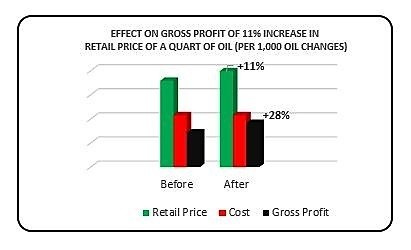
The following example drawn from a recent consulting situation illustrates the power to boost profits through a relatively quite minor increase in retail price:
1) A small boatyard, for whom I was consulting several years ago, performed about 1,000 engine oil changes per year.
2) Average number of oil quarts per engine oil change (including refilling the filter cannister) = 4
3) Existing retail pricing of engine oil per quart = $8.95
4) Wholesale cost of engine oil per quart = $5.37
5) Existing gross profit margin per quart = 40%
6) Gross profit per 1,000 engine oils and filter changes = $14,320.00
7) Raise retail price $1.00 per quart (total average raise in retail price = $4.00 per engine oil change)
8) New gross profit margin per quart = 46% (increase in gross profit margin = 15%)
9) New gross profit per 1,000 engine oil and filter changes = $18,320.00
10) Effective rise in gross profits on oil per 1,000 engine oil changes = 28% (from an 11% increase in the retail price of oil)
Competitive market pricing should always be tracked and considered
During the course of studying the retail pricing structure for batteries, which the yard was selling and installing, we also noticed that the operation was charging on average about $25.87 less per battery than the local store of a dominant national marine goods mass merchandiser. And the mass merchandiser's price was for carry-out, DIY installation, whereas the yards pricing included installation. Annual battery sales for the boatyard were running to more than 1,000 units, across the gamut of groups 24, 27, 31, 4D, and 8D.
To be sure, the boatyard was purchasing its batteries from a local supplier at very advantageous wholesale pricing, and the existing gross margin was significantly better than break-even. And to be sure, it is difficult at times to get more at retail for batteries than the low DIY carry-out price offered by mass merchandisers.
But because at equal pricing, there is no advantage to a customer for him or her to pick up and tote heavy batteries back to his or her boat, there is absolutely no reason to charge less. The retail pricing for batteries at the boatyard I was reorganizing was the result of an arbitrary cost-plus template — which is something that almost always should be rejected if your small business is to achieve strong profits levels. Consequently, we moved immediately to raise the boatyard’s retail pricing on batteries to match that of the competing mass merchandiser ― with the result that annual gross profit for this boatyard on maintenance and service goods rose more than $25,000, in little more time than it takes to snap your fingers.

If you apply similar reasoning, evaluation, and procedures to every item you sell — whether that’s oil filters, engine-water intake impellers, O/B and I/O engine lower unit lube, or other goods — the results can build into tens, even hundreds of thousands of dollars additional gross profit. And because pricing increases do not require additional overhead, that additional Gross Profit drops straight to the bottom line.
Moreover, if you apply price changes gradually and in moderation, your customer base will likely not resist, if it even notices at all. Always keep in mind that the objective is not to gouge or overbill your customers or clients, but rather to apply retail pricing raises to those items for which such raises will be readily accepted.
The idea is to price according to what is justified by the market and what your customer base will bear — and not in accord with some arbitrary cost-plus template. In my experience, cost-plus pricing results uniformly in lower profits than might otherwise be attained.
— Phil Friedman
Text Copyright © 2024 by Phil Friedman ― All Rights Reserved.
Postscript: This is the first installment of a serialization of my eBook, Small-Business Primer: Real -World Tips for Starting and Running Your Own Small Business. Subsequent installments will be published at irregular intervals over the next year in our MarineBiz Blog section. If you are a marine industry pro and interested in receiving these right into your email inbox, as they are released, simply subscribe below. I look forward to welcoming you aboard.