

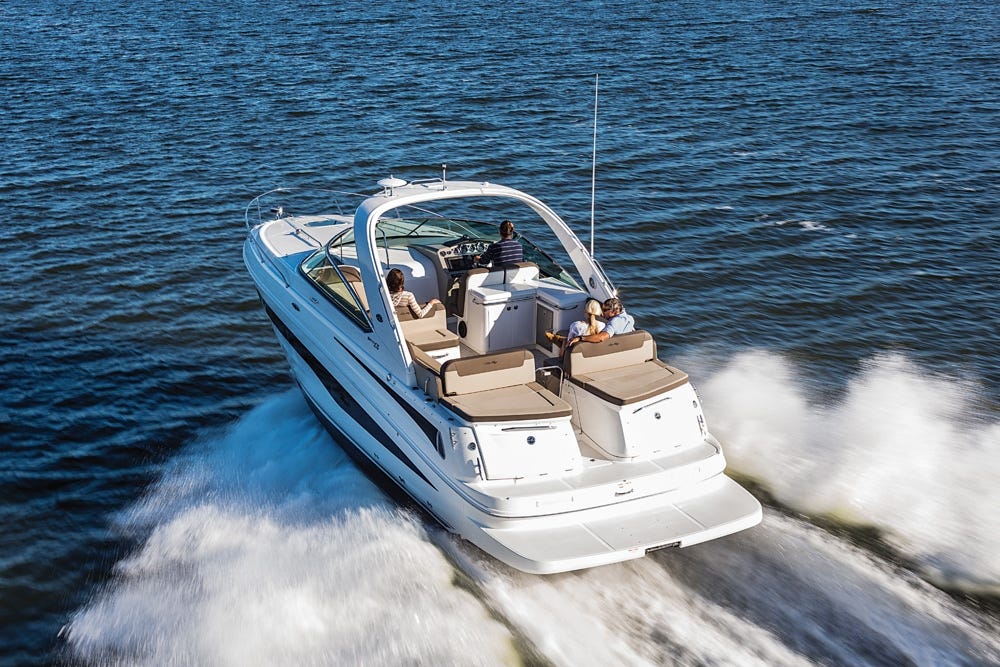
In 2012, the Sea Ray Venture 370 outboard cruiser was named Boat of the Year by Boating Magazine. By 2016 the Venture 370 was discontinued, supposedly because of “poor sales” — despite being wholesomely sensible and an early foreshadowing of the currently surging popularity of 4-stroke gasoline outboard power for mid-size cruisers.
Personally, I don’t believe the “poor sales” story for a New York minute. It was, in fact, an idea both long overdue and well before its time. As far as I can see, it was a solid concept caught up in Sea Ray’s general inability to maintain adequate quality- and cost-control, not to mention an endemic failure to find fresh vision for the motor yacht and sport yacht segment of its line. Witness Brunswick’s subsequent withdrawal in 2018 from that segment of the market.
The mystery of it is that the advent and ongoing evolution of 4-stroke gasoline outboard power makes a lot of sense from an engineering standpoint, for small to medium sized cruising yachts. Outboards generally exhibit significantly higher HP-to-Weight ratios. These days they don’t give much, if anything away to gasoline inboards in terms of reliability. They’re easier and more convenient to service, as well as being safer since, effectively, they are hung “outside” the boat — where dangerous fumes from raw fuel cannot build up. Indeed, about the only serious drawback to using outboards is that, hung on the ass end of a boat, they are butt ugly appendages. (My apologies to aficionados of modern six-engine offshore abominations for being so blunt.)
In boat and yacht design, evolution is a prime directive, and there is precious little, if anything at any given time that is 100% new…
In the mid-1950s — well before the Sea Ray Venture 370 debuted — a self-taught Idaho-based designer and commercial fishing boat builder, George Calkins, manufactured a series of plywood planing double-enders, 19’ to 26’ LOA, called “Bartenders”, so named because they were developed to cross the breaking river bars of the Columbia and other rivers of the Pacific Northwest.
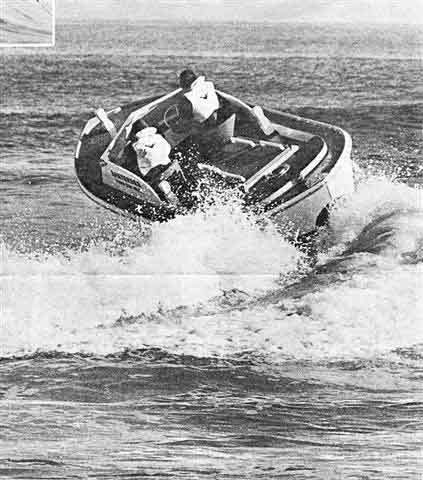
These small double-enders did not have a transom on which to mount an outboard, so Calkins employed what is known as an “outboard well” — a vertical watertight box that pierced the boat’s bottom and extended in height to well above the vessel’s static waterline. The outboard motor was mounted on the forward wall of the box with its prop and lower-end protruding through the hull into the water. The arrangement would not allow for significant trim movement and none for tilt, but much like an S or sail-drive, it eliminated the inboard gearbox and prop shaft setup which inevitably resulted in alignment complications. The setup retained the convenience of being able to easily hoist the engine out of the boat for major repair work or replacement.
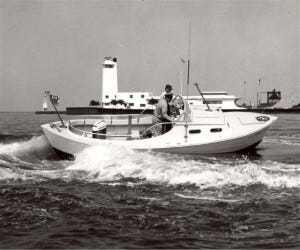
I was familiar with the Bartenders when, in 2020, I started to develop a new 12-meter motor yacht model for a consulting client of mine. And while the yacht involved was about as different from the Bartenders as you could get, I felt inspired by the earlier Bartender solution to integration of outboard power.
At the time, I was convinced that, if full advantage was to be taken of outboard power in the small to medium sized cruiser market, we needed to find a way to treat the o/b engine installation as integral to the yacht’s structure and styling, instead of in the common way as an apparent afterthought stuck on a stern bracket attached to the after face of the transom. So, with my preliminary conceptual sketches in hand, I contracted, on behalf of my client, with award-winning megayacht designer, J.C. Espinosa, to handle the exterior and interior styling and with John Canada of Oceans5 for the naval architecture and basic engineering. And I kept the matters of power package development for myself.
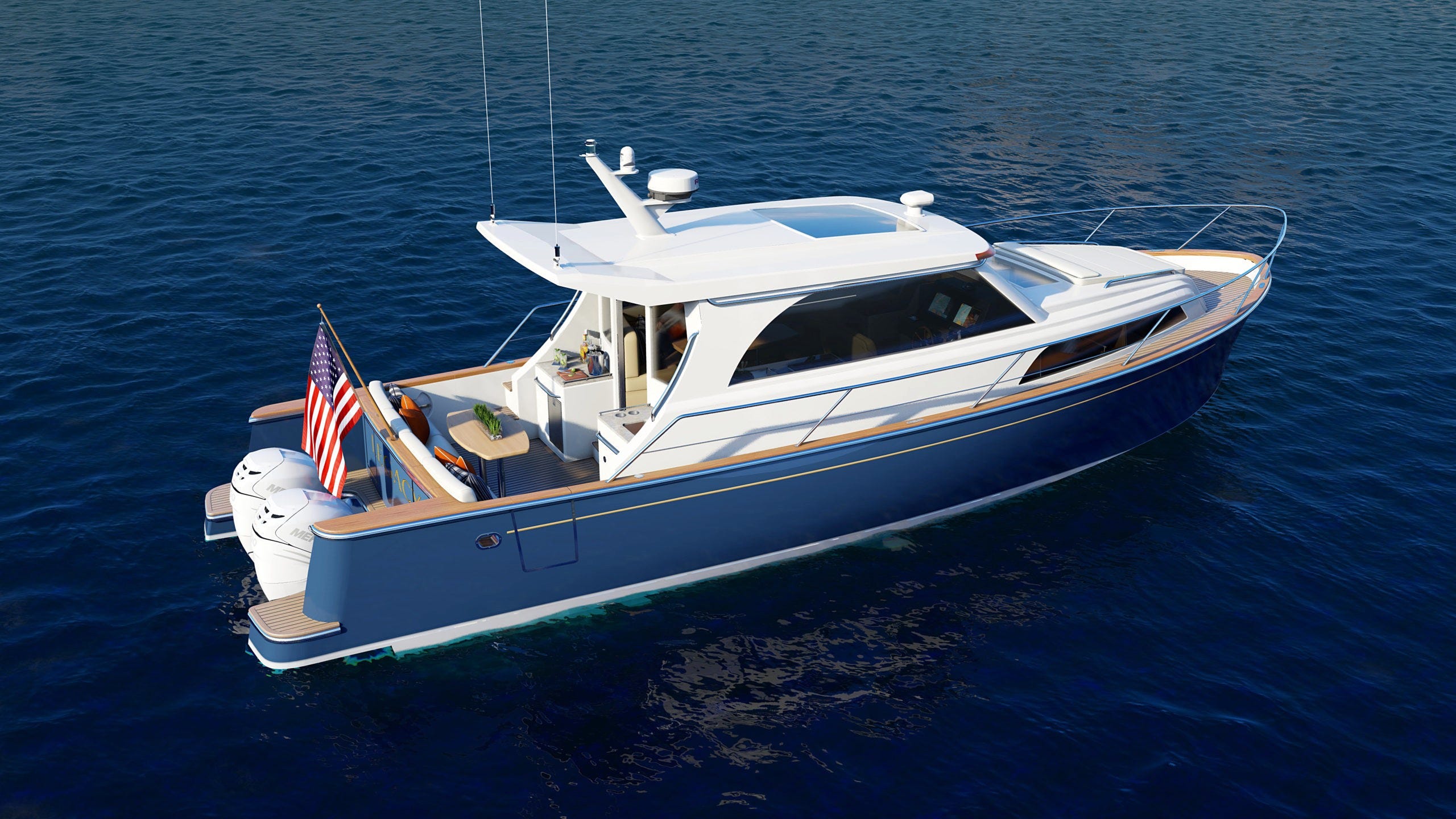
By extending the topsides of the boat well aft of the o/b engine-mounting transom (over fully buoyant hull bottom sections) we were able to create a truly integrated look for the outboard engine installation. The buoyant hull bottom extensions also balanced the weight of the twin 400-HP standard engines placed right aft and prevented the all too prevalent static stern-squat that is sold by so many builders as a “racy look”, but which is really, IMO, a failure of design hydrostatics forethought. The result was, I felt at the time, an instance of outboard-powering achieving full maturity.
However, looking at the subject in hindsight, it occurs to me that, perhaps, the treatment expressed in the Sea Ray Venture 370 was a more advanced evolutionary step for outboard power, as it camouflaged the engines entirely with a ventilated faux stern platform-cum-cowl…


But ultimately, that’s a question best left to you, the reader, to judge. Was/is the Sea Ray approach superior? And is there anything to be said or not for improved integration of outboard power into the overall styling of a cruising motor yacht? Feel free to leave a comment, so the rest of us can see what the consensus is. Fair winds and safe harbors — Phil Friedman
Copyright © 2024 by Phil Friedman and Port Royal Group — All Rights Reserved
Reader and designer, Tad Roberts, writes:
"Phil, the Bartender outboard well is quite long IRL and does allow trimming and tilting the motor right up. George had a hinged filler piece, I think he might have called it a planing board that dropped down to fair with the hull bottom when the motor was down. Here's a picture with motor and planing board up...."